
Low ferritin without anemia: the guide women are not given
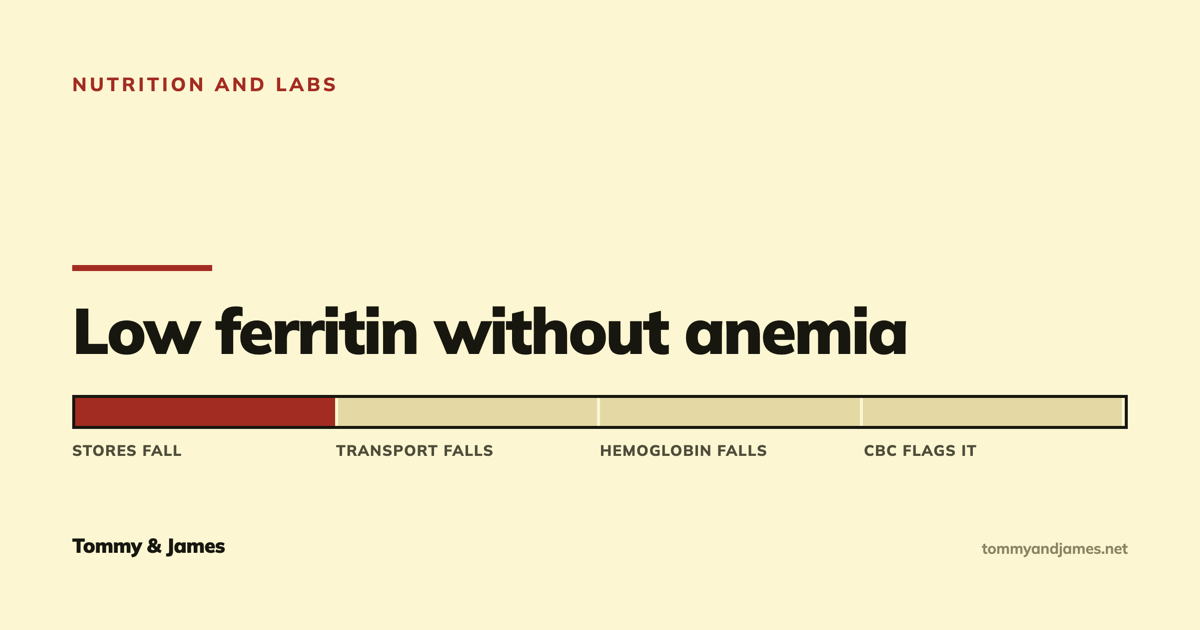
You can be genuinely iron deficient with a textbook-normal blood count. Iron depletion runs through three stages and anemia is the third, so ferritin drops long before hemoglobin does. WHO sets iron deficiency at a ferritin below 15 micrograms per litre in healthy adults, and below 70 when inflammation is present, because ferritin is an acute phase protein.
Iron deficiency runs through three stages, and only the third one is anemia. The Institute of Medicine’s dietary reference intake review for iron names them in order: depleted iron stores, then early functional iron deficiency, then iron deficiency anemia. The RDA is 18 mg of iron a day for premenopausal women and 8 mg a day for men and postmenopausal women, with a tolerable upper intake level for adults of 45 mg a day. The World Health Organization sets the ferritin threshold for depleted stores in an apparently healthy adult at 15 micrograms per litre, and raises it to 70 when infection or inflammation is present.
Why does a normal blood count not rule out iron deficiency?
Because hemoglobin is the last marker to fall, not the first. A complete blood count measures the functional compartment: the iron already inside circulating red cells. Storage iron empties first, and the body will strip the stores bare to keep hemoglobin in range.
The DRI review is blunt about the middle stage. In early functional iron deficiency, the supply of iron to tissues is suboptimal but, in its words, “a measurable decrease in the hemoglobin concentration is not yet present and therefore there is no anemia.” That is a defined clinical state with a normal CBC.
The same document notes that hemoglobin “is neither a sensitive nor a specific indicator of mild yet functionally significant iron deficiency.” A woman can sit at the low end of normal for years while her stores run to zero. Nothing on the CBC print-out flags it.
A normal hemoglobin tells you the last compartment has not failed yet. It says nothing about the first one.
What actually happens first when iron runs low?
Storage iron depletes, then transport falters, then red cell production suffers. Ferritin tracks stage one. Transferrin saturation and total iron binding capacity move in stage two. Hemoglobin and mean corpuscular volume move in stage three, and by then the deficit has been building for a long time.
The arithmetic is unforgiving. The DRI review reports that each 1 microgram per litre of serum ferritin represents roughly 8 mg of storage iron, and that below 12 micrograms per litre the stores are totally depleted. An adult woman carries only a few hundred milligrams of storage iron at best.
Absorption is the bottleneck. An adult man needs to absorb about 1 mg a day to stay in balance. The average menstruating woman needs about 1.5 mg, and the review notes that a small proportion must absorb as much as 3.4 mg a day. Diet has very little headroom above that.
What is on a full iron panel, and what does each marker actually mean?
Six markers do the work, and each one has a failure mode. Ferritin measures stores but rises with inflammation. Transferrin saturation measures delivery but falls in anemia of chronic disease too. Soluble transferrin receptor measures tissue demand and is the one marker inflammation does not distort.
Every threshold below was read off the source document rather than a secondary summary, which is how we check a number before it goes on the page. The values come from the Institute of Medicine review and the WHO ferritin guideline directly.
| Marker | What it measures | What an abnormal value suggests | The catch |
|---|---|---|---|
| Ferritin | Size of the iron store | WHO: below 15 mcg/L in a healthy adult indicates iron deficiency; below 12 mcg/L means stores are totally depleted | An acute phase protein. Rises with infection, inflammation, liver disease, cancer, alcohol and higher BMI |
| C-reactive protein | Systemic inflammation | WHO treats CRP above 5 mg/L as elevated inflammation | Not an iron marker at all. It exists to tell you whether the ferritin can be read at face value |
| Transferrin saturation | Iron actually in transit to tissues | Below 16 percent means delivery is too slow for normal hemoglobin synthesis | Also low in anemia of chronic disease. Swings with recent meals and time of day |
| Total iron binding capacity | Transferrin available to carry iron | Above 400 mcg/dL indicates storage iron depletion | Rises before delivery fails, but is less precise than ferritin |
| Soluble transferrin receptor | How hard tissues are asking for iron | Rises in proportion to the functional iron deficit | Not affected by infectious, inflammatory or neoplastic disorders, which is its value. Assays vary between labs |
| Hemoglobin | Iron already inside red cells | Falls only at the third and final stage | Neither sensitive nor specific for mild but functionally significant deficiency |
Is a ferritin inside the reference range the same as an adequate ferritin?
No, and this is the most consequential misunderstanding in the whole area. A laboratory reference range describes what a sampled population produced. It is not a statement about what a body needs. Many US labs report a lower ferritin limit in the single digits, which sits below the point at which the DRI review says stores are totally depleted.
The reference range answers “is this result unusual”, not “is this person iron replete”. Those are different questions and only one of them matters to a tired 43 year old.
Population data show the scale of the gap. In NHANES III, median serum ferritin was 36 to 40 micrograms per litre in menstruating women and 112 to 156 micrograms per litre in men. The typical woman is running her whole life at roughly a third of the typical male store. My view as the writer: reporting ferritin against an undifferentiated adult range, with no flag when a menstruating woman lands in the teens, is the weakest link in ordinary lab practice.
Why can inflammation make a low ferritin look normal?
Ferritin is an acute phase protein, so it climbs during inflammation regardless of how much iron is in storage. The DRI review states that concentrations rise with infections, inflammatory disorders, cancers and liver disease, and adds the sentence that should be printed on every lab slip: serum ferritin “may fall within the normal range in individuals who have no iron stores.”
Elevated ferritin also tracks with alcohol intake, rising body mass index and elevated plasma glucose. None of those mean the iron store is full.
This is why WHO recommends measuring ferritin alongside acute phase proteins, specifically CRP and alpha-1 acid glycoprotein, wherever inflammation is common. It is also why WHO offers a second threshold: in an individual with infection or inflammation, a ferritin below 70 micrograms per litre may indicate iron deficiency, rather than the usual 15.
Ferritin without an inflammatory marker is a number you cannot interpret. A ferritin of 45 means one thing with a CRP of 1 and something quite different with a CRP of 12. Ordering them together costs almost nothing and removes the ambiguity.
Can you feel iron deficient without being anemic?
The trial evidence says yes. Vaucher and colleagues, writing in CMAJ, randomised 198 menstruating women aged 18 to 53 who reported unexplained fatigue, all with ferritin below 50 micrograms per litre and hemoglobin above 12.0 g/dL. Every participant had a normal hemoglobin by definition.
Fatigue scores fell 47.7 percent in the iron group against 28.8 percent on placebo, a difference of 18.9 percentage points (95% CI -34.5 to -3.2, p=0.02). The same trial found no significant effect on quality of life, depression or anxiety scores. That combination is worth sitting with: the fatigue moved, the mood measures did not.
Brain iron matters separately. The International Restless Legs Syndrome Study Group task force, reporting in Sleep Medicine, concluded that oral iron is possibly effective for restless legs at serum ferritin at or below 75 micrograms per litre. If your legs are the reason you are awake at three in the morning, iron status is part of that conversation.
Why do heavy periods drain iron faster than food replaces it?
Menstrual loss is the dominant variable in female iron balance, and it is the one nobody quantifies. ACOG states that heavy menstrual bleeding is very common and that about one third of women seek treatment for it, and lists the markers: bleeding lasting more than seven days, soaking through a pad or tampon every hour for several hours running, needing to change protection overnight, or clots the size of a quarter or larger.
The Office on Women’s Health reports that up to 5 percent of women of childbearing age develop iron deficiency anemia because of heavy menstrual bleeding. The number with depleted stores and no anemia is necessarily larger, because that stage comes first.
Bleeding often gets heavier and less predictable during the menopause transition, which is one of the changes women are rarely warned about. An 18 mg RDA assumes an average loss. It does not cover a heavy one.
Is every other day iron dosing better than daily dosing?
For absorption, yes, and the mechanism is hepcidin. An oral iron dose triggers a rise in the hormone hepcidin that suppresses absorption of the next dose. Stoffel and colleagues, reporting in Haematologica, found that this hepcidin rise persists for 24 hours, which means a dose given the same day or the next morning lands into a closed door.
In that cross-over study of women with iron deficiency anemia, fractional iron absorption on the alternate day was 40 to 50 percent higher than on the second of two consecutive days. An earlier Lancet Haematology trial from the same ETH Zurich group found the same pattern in iron-depleted women without anemia, and also found that splitting a daily dose into two raised hepcidin further while adding nothing to total absorption.
The longer trial complicates the story. In a double-blind randomised study in eClinicalMedicine, von Siebenthal and colleagues followed 150 women with ferritin at or below 30 micrograms per litre. At equal total iron doses, median ferritin ended up the same in both groups, 43.8 against 44.8 micrograms per litre. Alternate-day dosing did produce lower hepcidin, fewer gastrointestinal side effects, and less iron deficiency at six months (3.0 versus 11.4 percent).
What helps and what blocks iron absorption?
Heme iron, the form in meat, poultry and fish, is highly bioavailable and largely unaffected by what else is on the plate. Non-heme iron, which is most of what people eat, is the form that everything interferes with.
Ascorbic acid strongly enhances non-heme absorption by reducing ferric iron to the ferrous form and holding it soluble in the stomach. Working against it: calcium, which the DRI review notes inhibits both heme and non-heme absorption, and polyphenols. Tea was the first food shown to block iron absorption, through tannic acid binding iron into an insoluble complex in the gut. The effect is dose-dependent and is partly offset by vitamin C.
Phytates in whole grains and legumes inhibit absorption, and soy protein does so independently of its phytate. Reduced stomach acid also impairs absorption, whether from heavy antacid use, achlorhydria or partial gastrectomy.
Why do so many people quit iron before it works?
Because the side effects arrive immediately and the benefit does not. The NHLBI states plainly that restoring iron levels often takes three to six months. Nausea, constipation, diarrhoea and a metallic taste arrive on day two.
The eClinicalMedicine trial put a number on the trade-off. On days when iron was taken, the longitudinal prevalence ratio for gastrointestinal side effects was 1.56 in the consecutive-day group compared with alternate-day (95% CI 1.38 to 1.77, p<0.0001). The DRI review notes that the 45 mg upper limit for adults was set on gastrointestinal distress as the adverse effect, not on toxicity.
None of that tells you what to take. Dose, formulation, schedule and whether oral iron is appropriate at all are clinical decisions, and they depend on the cause of the loss. The detail of what a low ferritin with a normal hemoglobin actually looks like on a report is worth reading before the appointment.
When is taking iron genuinely dangerous?
When the body has no way to get rid of it. Humans have no regulated excretion route for iron, so intake that exceeds need accumulates. The NIDDK describes hemochromatosis as a disorder in which extra iron builds up to harmful levels, damaging the liver, heart, pancreas, endocrine glands and joints. Its early symptoms include fatigue, weakness and joint pain, which are the same symptoms that send people to buy iron in the first place.
For people with hemochromatosis, the NIDDK notes that clinicians may advise avoiding iron and vitamin C supplements entirely. The Office on Women’s Health advises not exceeding 45 mg of iron a day unless a doctor prescribes more.
WHO sets ferritin thresholds at the other end too: above 150 micrograms per litre in menstruating women and above 200 in men and non-menstruating women may indicate risk of iron overload, and WHO is explicit that ferritin should not be used alone to identify it.
Low iron is a symptom of something, not a diagnosis. In an adult it can mean menstrual loss, coeliac disease, an ulcer, or gastrointestinal bleeding that needs finding. Supplementing without establishing the cause can mask a bleed for months. Interpreting ferritin, CRP, transferrin saturation and hemoglobin together, and deciding what if anything to do about them, is a clinical judgement. Meredith Kane is a health writer, not a clinician, and this page is not medical advice.
What is worth asking for at the appointment?
Ask for the numbers, not the verdict. A CBC alone cannot answer the question, because it only reads the last of the three stages. The markers that read the first two stages are ferritin, CRP, transferrin saturation and total iron binding capacity, with soluble transferrin receptor available when inflammation muddies the picture.
- Ask what your actual ferritin value was, in micrograms per litre, rather than whether it was “normal”.
- Ask whether a CRP was run at the same time, since without it a mid-range ferritin cannot be interpreted.
- Describe your bleeding using the ACOG markers, in hours and pad counts, not adjectives.
- Ask what the working explanation for the loss is, and what would change the plan.
Bring the ACOG bleeding criteria written down. “Heavy” is a word that gets discounted. “Soaking through a pad every hour for four hours” is data.
Questions readers ask
Can you have iron deficiency with a normal hemoglobin?
Yes. The Institute of Medicine describes three stages: depleted stores, early functional iron deficiency, then iron deficiency anemia. In the middle stage, iron supply to tissues is suboptimal but hemoglobin has not measurably fallen, so a complete blood count reads as normal.
What ferritin level counts as iron deficiency?
WHO sets iron deficiency in apparently healthy adults at a serum ferritin below 15 micrograms per litre. In individuals with infection or inflammation, WHO uses a higher threshold of 70 micrograms per litre, because inflammation falsely raises ferritin.
Why does my doctor need to check CRP with ferritin?
Ferritin is an acute phase protein, so it rises with infection, inflammatory disorders, liver disease and cancer. WHO recommends measuring CRP alongside ferritin, treating CRP above 5 mg/L as elevated inflammation, so a normal-looking ferritin is not mistaken for adequate iron stores.
Is alternate day iron dosing better than daily?
For absorption, yes. An oral iron dose raises hepcidin for 24 hours, suppressing absorption of the next dose. Trials found fractional absorption 40 to 50 percent higher on alternate days and fewer gastrointestinal side effects. Dosing decisions are clinical and depend on the cause of the loss.
Is it safe to take iron supplements without testing?
No. The body has no route to excrete excess iron. Iron overload damages the liver, heart, pancreas, endocrine glands and joints, and early hemochromatosis symptoms mimic deficiency. Low iron also signals an underlying cause, such as a gastrointestinal bleed, that supplementing can mask.
Not medical advice. Tommy & James is an independent publication, not a clinic and not affiliated with any health agency, laboratory or supplement brand. This article is general information for healthy adults. Speak to a clinician who knows your history before you start, stop or change any medication, supplement or treatment.
Sources
- Institute of Medicine, Dietary Reference Intakes for Vitamin A, Vitamin K, Arsenic, Boron... Iron chapter (NIH Bookshelf)
- WHO guideline on use of ferritin concentrations to assess iron status in individuals and populations
- Stoffel NU et al. Iron absorption from supplements is greater with alternate day than with consecutive day dosing in iron-deficient anemic women. Haematologica
- von Siebenthal HK et al. Alternate day versus consecutive day oral iron supplementation in iron-depleted women: a randomized double-blind placebo-controlled study. eClinicalMedicine
- Vaucher P et al. Effect of iron supplementation on fatigue in nonanemic menstruating women with low ferritin: a randomized controlled trial. CMAJ
- ACOG, Heavy Menstrual Bleeding (Frequently Asked Questions)
- NHLBI, Iron-Deficiency Anemia
- NIDDK, Hemochromatosis
Every link above was opened and checked on 2026-09-08. If one has moved, tell us and we will fix it.