
Normal hemoglobin, low ferritin: why heavy periods hide iron deficiency
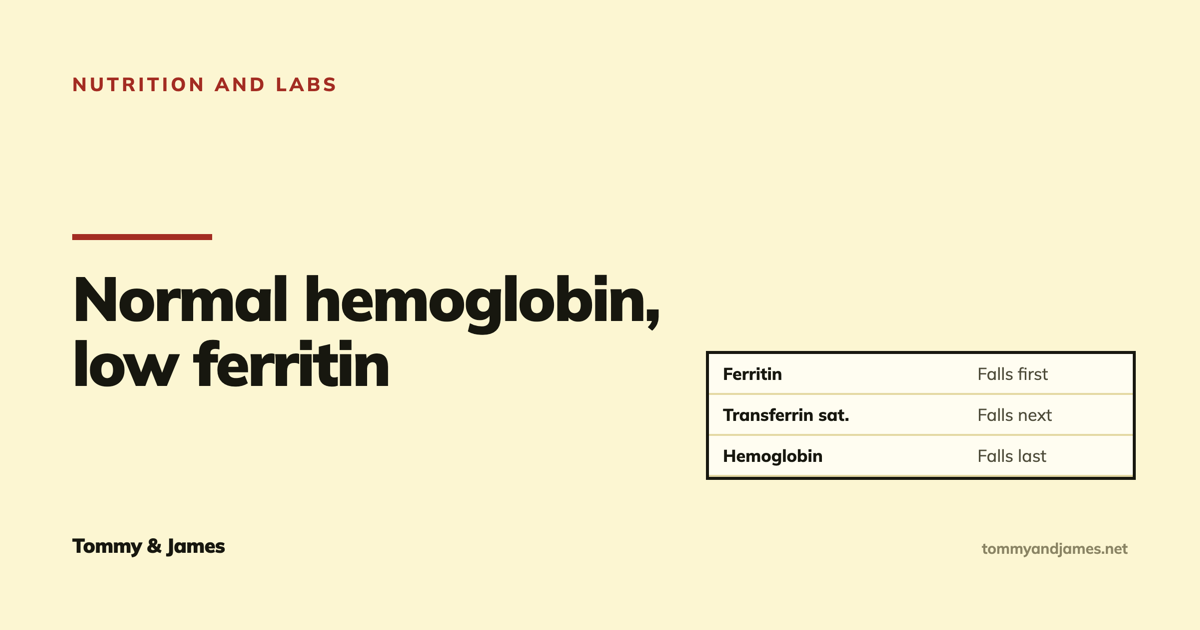
Yes. Iron depletion runs in stages and hemoglobin falls last. Storage iron goes first, which ferritin measures. Transport iron goes next, which transferrin saturation measures. Only then does hemoglobin drop and the CBC look abnormal. WHO sets the adult ferritin cut-off at under 15 micrograms per liter, a number no complete blood count reports.
The Food and Nutrition Board sets the iron RDA at 18 mg a day for premenopausal women and 8 mg a day for men and postmenopausal women. The World Health Organization puts the ferritin cut-off for iron deficiency in apparently healthy adults aged 20 to 59 at under 15 micrograms per liter. Hemoglobin appears in neither figure. Iron deficiency is graded in three stages, and anemia is the third one. In NHANES III, median serum ferritin was 36 to 40 micrograms per liter in menstruating women against 112 to 156 micrograms per liter in men.
Can heavy periods cause low ferritin with normal hemoglobin?
Yes, and it is the ordinary sequence rather than an exception. Ferritin measures storage iron and falls first. Hemoglobin sits in the functional compartment and falls last. A woman losing iron every cycle can empty her stores while her complete blood count stays inside the reference range.
The Dietary Reference Intakes chapter on iron is explicit about the order. It identifies three levels of iron deficiency: depleted iron stores, then early functional iron deficiency, then iron deficiency anemia. Only the third one registers on a CBC.
The arithmetic is unforgiving. Each 1 microgram per liter of serum ferritin represents roughly 8 mg of storage iron in an adult. A woman with a ferritin of 12 has almost nothing banked, yet her marrow can still assemble normal red cells for months by drawing down what is left. That interval, deficient but not yet anemic, is the subject of our pillar page on low ferritin without anemia.
What are the stages of iron deficiency, in order?
Three stages, in this order: storage depletion, iron-deficient erythropoiesis, then iron deficiency anemia. Ferritin marks the first. Transferrin saturation marks the second. Hemoglobin marks the third. A standard complete blood count only detects the last stage, which is why timing determines whether the test finds anything.
Storage depletion means ferritin is falling while everything else holds. Early functional iron deficiency means the supply reaching the bone marrow is suboptimal but has not yet reduced hemoglobin. The DRI text notes that transferrin saturation below 16 percent indicates the rate of iron delivery is insufficient to maintain a normal rate of hemoglobin synthesis. Anemia arrives only after both buffers are gone.
WHO describes the same split in terms of compartments. Serum ferritin assesses storage iron, while transferrin saturation reflects the iron supply to tissues. The guideline adds that even in the absence of anemia, iron deficiency appears to be associated with clinical signs and symptoms including fatigue.
| Stage | What is happening | Marker that moves | Caught by a standard CBC? |
|---|---|---|---|
| 1. Depleted iron stores | Storage iron is drawn down to cover ongoing losses | Serum ferritin falls, under 15 micrograms per liter by the WHO adult cut-off | No. Ferritin is not part of a CBC |
| 2. Iron-deficient erythropoiesis | Iron supply to the bone marrow is suboptimal but hemoglobin synthesis is still keeping up | Transferrin saturation drops, under 16 percent | No. Transferrin saturation is a separate iron panel |
| 3. Iron deficiency anemia | A measurable deficit appears in the erythrocyte itself | Hemoglobin and hematocrit fall, red cells turn microcytic | Yes, and only now |
What counts as heavy menstrual bleeding?
ACOG lists five concrete signs, not a feeling. Bleeding lasting more than 7 days. Soaking through one or more pads or tampons every hour for several hours in a row. Needing more than one pad at a time. Needing to change protection during the night. Clots as big as a quarter or larger.
Those five are the reason the deficiency goes unnoticed. Nobody compares flow with anyone else, so a period that has always been heavy reads as normal to the person having it. ACOG also states that about one third of women seek treatment for heavy menstrual bleeding, and that blood loss from heavy periods can lead to iron-deficiency anemia.
The night criterion is worth isolating. If you set an alarm or wake on your own to change a pad, that is on the ACOG list, and it is also a sleep disruption that gets attributed to something else entirely. We cover the other reasons for waking up at night separately.
Why does a normal CBC miss low iron stores?
Because a CBC measures the red cells, not the bank behind them. It reports hemoglobin, hematocrit, red cell count and cell size. It does not report ferritin, serum iron, transferrin saturation or total iron binding capacity. Those are ordered separately, and only if somebody thinks to.
The DRI chapter puts the limitation bluntly: the hemoglobin concentration or hematocrit is neither a sensitive nor a specific indicator of mild yet functionally significant iron deficiency anemia. Sensitivity is the problem here. Reference ranges are wide, so a woman can lose a third of her usual hemoglobin territory and still land inside normal.
A normal CBC rules out anemia. It does not rule out iron deficiency, and those are different questions.
This is the writer’s view, and it is a real criticism of routine practice: treating the CBC as an iron test is the weakest link in the whole chain, because it guarantees the deficiency is only found at the stage where it has already cost you red cells.
Can inflammation make a ferritin result look normal?
Yes. Ferritin is an acute-phase protein, so infection, inflammatory disease, liver disease and obesity all push it up independently of iron stores. The DRI chapter states the consequence directly: serum ferritin concentration may fall within the normal range in individuals who have no iron stores. That is why CRP is measured alongside it.
WHO handles this by raising the bar rather than ignoring the result. Its guideline recommends that in individuals with infection or inflammation, a ferritin concentration below 70 micrograms per liter in adults may be used to indicate iron deficiency, against 15 in apparently healthy adults. For population surveys it recommends measuring two acute-phase proteins, C-reactive protein and alpha-1 acid glycoprotein, alongside ferritin.
We read that threshold table inside the WHO guideline itself rather than taking it from a secondary summary, which is how we check every number here. Our research method explains the rest.
What ferritin number counts as low?
WHO sets the cut-off for apparently healthy adults aged 20 to 59 at under 15 micrograms per liter, and under 70 micrograms per liter when infection or inflammation is present. The DRI chapter puts total depletion of stores at under 12 micrograms per liter. Laboratory reference ranges are often much wider than either.
The gap between a lab’s lower reference limit and a guideline cut-off is where most of the confusion lives. A result can be flagged as normal by the printout and still sit below the WHO threshold. Ask which number your result is being compared against.
Context matters in the other direction too. WHO notes that ferritin above 150 micrograms per liter in menstruating women may indicate a risk of iron overload. Falling estrogen and changing cycle length shift the whole picture during the transition, which is one of the perimenopause symptoms nobody warns you about.
What should you ask your clinician to test?
Ask whether a serum ferritin with a CRP is reasonable given your bleeding pattern, alongside the CBC rather than instead of it. Bring the ACOG criteria you actually meet. That request is specific and staged correctly.
The reason is documented, not rhetorical. WHO states that the most common cause of blood loss is menstruation, which is the primary reason iron deficiency is more common in women. The Office on Women’s Health reports that up to 5 percent of women of childbearing age develop iron-deficiency anemia because of heavy bleeding during their periods, and NHLBI lists heavy menstrual periods among the causes of iron-deficiency anemia.
The Office on Women’s Health goes one step further and names the trigger for testing. It advises talking to your doctor about getting tested as part of your regular health exam if you have heavy menstrual periods. That is a documented reason to ask, and it does not require you to argue that anything is wrong yet.
Nothing here is a reason to buy a supplement. The Tolerable Upper Intake Level for iron in adults is 45 mg a day, set on gastrointestinal distress. Iron overload is a real condition: NIDDK reports that about 1 in 15 people of Northern European ancestry carry at least one copy of the C282Y mutation behind hereditary hemochromatosis, and about 1 in 225 carry two. Iron is also worth measuring before it is replaced, because the cause of the loss matters as much as the number. MedlinePlus notes that a provider will usually measure your iron level before you start supplements. Testing and treatment decisions belong to a clinician.
Is heavy menstrual bleeding itself worth investigating?
Yes, separately from the iron question. Heavy menstrual bleeding is a finding in its own right. ACOG lists fibroids, polyps, adenomyosis, irregular ovulation, bleeding disorders, medications and endometrial cancer among its causes, and states plainly that heavy menstrual bleeding is not normal.
A ferritin result answers one question. It does not answer why the bleeding is heavy, and that second question deserves its own appointment. ACOG notes that irregular ovulation is common during perimenopause, which is exactly the window where a woman is most likely to attribute a changing period to age and stop there.
If you want the full test menu before the appointment, MedlinePlus lists what a workup for iron deficiency anemia usually includes: a CBC and reticulocyte count, then serum iron, total iron binding capacity and serum ferritin, then tests to find the source of blood loss.
Questions readers ask
Can you be iron deficient with normal hemoglobin?
Yes. The Dietary Reference Intakes identify three levels of iron deficiency: depleted stores, early functional deficiency, then anemia. Ferritin falls in the first stage. Hemoglobin only falls in the third, so a normal complete blood count does not rule iron deficiency out.
What ferritin level is considered low?
WHO sets the cut-off for apparently healthy adults aged 20 to 59 at under 15 micrograms per liter, and under 70 micrograms per liter when infection or inflammation is present. The Dietary Reference Intakes put total depletion of stores at under 12 micrograms per liter.
What does ACOG count as heavy menstrual bleeding?
ACOG lists bleeding lasting more than 7 days, soaking through one or more pads or tampons every hour for several hours in a row, needing more than one pad at a time, changing protection during the night, and clots as big as a quarter or larger.
Why is CRP tested with ferritin?
Ferritin is an acute-phase protein, so infection, inflammatory disease, liver disease and obesity raise it independently of iron stores. The Dietary Reference Intakes note ferritin can sit in the normal range in people with no iron stores at all, so CRP flags when the result needs a higher threshold.
How much iron do menstruating women need daily?
The Food and Nutrition Board sets the RDA at 18 mg a day for premenopausal women and 8 mg a day for postmenopausal women. The Tolerable Upper Intake Level for adults is 45 mg a day, based on gastrointestinal distress as the adverse effect.
Not medical advice. Tommy & James is an independent publication, not a clinic and not affiliated with any health agency, laboratory or supplement brand. This article is general information for healthy adults. Speak to a clinician who knows your history before you start, stop or change any medication, supplement or treatment.
Sources
- Institute of Medicine, Dietary Reference Intakes: Iron (NCBI Bookshelf)
- WHO guideline on use of ferritin concentrations to assess iron status
- ACOG, Heavy Menstrual Bleeding FAQ
- HHS Office on Women's Health, Iron-deficiency anemia
- NHLBI, Iron-Deficiency Anemia
- NIDDK, Hemochromatosis: Definition and Facts
- MedlinePlus, Iron deficiency anemia
- Food and Nutrition Board, DRI Recommended Dietary Allowances, Elements (NCBI Bookshelf)
Every link above was opened and checked on 2026-09-08. If one has moved, tell us and we will fix it.
This page was last reviewed on 2026-09-08. We re-read the sources on every review and change the text when the evidence changes. How we research.