
The perimenopause symptoms nobody warns you about
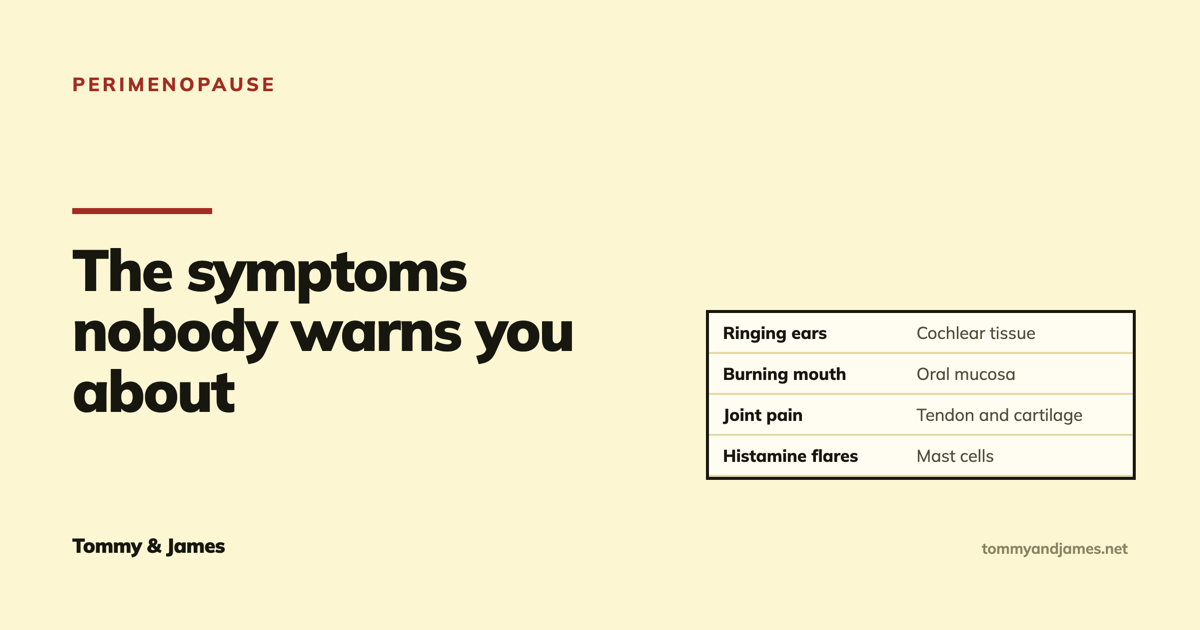
Perimenopause produces symptoms far outside the reproductive tract because estrogen receptors sit in the inner ear, oral tissue, joints, skin, blood vessels and immune cells. That explains ringing ears, burning mouth, joint pain, palpitations, cold flashes and itch. Evidence quality varies sharply across that list, and thyroid disease, iron deficiency and sleep apnea share the same symptoms.
Menopause is a single day, and it is only ever confirmed backwards. Reading the National Institute on Aging page, the marker is twelve consecutive months with no period and no spotting. Most women begin the menopausal transition between ages 45 and 55, and the average age of menopause in the United States is 52. The STRAW+10 staging system defines the early menopausal transition as a persistent difference of 7 days or more in the length of consecutive cycles, and the late transition as an amenorrhea interval of 60 days or longer. The NIA states that symptoms can last between two and eight years.
Why would perimenopause cause symptoms nowhere near the ovaries?
Because estrogen receptors are not confined to the reproductive tract. Estrogen receptor alpha and estrogen receptor beta have been mapped in the human inner ear, oral epithelium, salivary glands, joints, skin, blood vessels and immune cells. Estradiol in perimenopause does not fall smoothly, it swings. Every tissue carrying those receptors is exposed to the swing.
Stenberg and colleagues, publishing in Hearing Research in 2001, immunostained adult human inner ear tissue and found estrogen receptor alpha in the spiral ganglion and estrogen receptor beta in the stria vascularis. Välimaa and colleagues, in the Journal of Endocrinology in 2004, found ERβ widely expressed in oral keratinocytes and salivary gland cells, with ERα not detected at all.
That is receptor mapping. It is not proof that a falling estradiol level produced the ringing in your ears or the burning on your tongue. Those two facts have to be held apart, and most of this page sits in the gap between them.
Receptor presence explains why a symptom is biologically plausible. It does not prove the symptom is hormonal in you.
Which perimenopause symptoms are the ones nobody warns you about?
The public list is hot flashes, night sweats, irregular periods, sleep trouble and mood change. The longer list, barely covered by US national health bodies, includes ringing ears, positional dizziness, a burning mouth, new joint and tendon pain, palpitations, cold flashes, itchy skin and allergy-type flares.
Two of those do appear in federal guidance. The NIA names joint and muscle discomfort directly. The Office on Women’s Health notes that some women get more cold chills, also called cold flashes, than hot flashes, and that as many as two out of three women in perimenopause report memory or concentration problems.
The rest are absent. The National Institute on Deafness and Other Communication Disorders lists noise exposure, hearing loss, medications, earwax, head injury, Ménière’s disease, jaw problems, tumors, blood vessel problems, diabetes, migraine, thyroid disorders, anemia and autoimmune disease as tinnitus causes, and does not name menopause at all. That silence is the reason these searches return micro-blogs.
What else could each of these symptoms be?
This is the column every symptom list skips. A strange symptom in your forties has a differential, and several items on it are common, cheap to test for and genuinely treatable. Thyroid disease, iron deficiency and sleep apnea sit near the top of that list.
| Symptom | Tissue with documented estrogen receptors | What else it could be | When it warrants a clinician |
|---|---|---|---|
| Ringing or buzzing ears | Spiral ganglion (ERα), stria vascularis (ERβ) | Noise exposure, hearing loss, NSAIDs and other drugs, earwax, thyroid disorder, anemia, migraine | One ear only, pulsatile, or with hearing loss or vertigo. NIDCD notes imaging is often ordered for pulsatile tinnitus |
| Spinning when you roll over in bed | Otoconia and otic capsule bone | Benign paroxysmal positional vertigo, Ménière’s disease, vestibular migraine, low blood pressure, anemia | Any first episode of true spinning, or vertigo with hearing change, double vision, weakness or severe headache |
| Burning tongue, lips or palate | Oral epithelium and salivary glands (ERβ predominant) | Dry mouth, Sjögren’s disease, oral yeast infection, acid reflux, dental material allergy, diabetes, thyroid problems, low B vitamins or iron | Daily burning for more than two hours a day over three months. NIDCR says a dentist should rule out other causes first |
| New joint, tendon and muscle pain | Cartilage, tendon, synovium, muscle, bone | Osteoarthritis, rheumatoid arthritis and other autoimmune disease, hypothyroidism, vitamin D deficiency, overuse injury | Swelling, morning stiffness beyond 30 minutes, symmetrical small-joint pain, fever, or one hot painful joint |
| Palpitations, often worse lying down | Vascular endothelium, cardiac tissue | Anemia, hyperthyroidism, anxiety, caffeine and stimulants, arrhythmia, sleep apnea | Palpitations with chest pain, breathlessness, fainting or near-fainting, or a known heart condition. These need same-day assessment |
| Feeling cold constantly, or cold flashes | Hypothalamic thermoregulatory centres | Hypothyroidism, iron deficiency anemia, low body weight. NHLBI lists chills among general anemia symptoms | Cold intolerance with fatigue, weight gain, joint pain and heavy periods, which is the classic hypothyroid cluster |
| Itchy skin, scalp or ear canals | Skin keratinocytes, sebaceous glands | Eczema, dry skin, contact dermatitis, iron deficiency, thyroid disease, liver or kidney disease, drug reaction | Itch without a rash that persists, itch with jaundice, or itch that wakes you nightly |
| New or worse allergy-type flares | Mast cells and other immunoregulatory cells | Genuine new allergy, chronic urticaria, mastocytosis, drug reaction, thyroid autoimmunity | Any swelling of lips, tongue or throat, wheeze, or faintness with a reaction. That is emergency care, not a clinic appointment |
Can perimenopause cause ringing in your ears?
The honest answer is that nobody has shown it. Estrogen receptors sit in the human inner ear, and small observational studies have reported tinnitus clustering around the menopausal transition. No US national health body lists menopause as a tinnitus cause, and no trial has shown that treating the hormone change treats the sound.
The NIDCD puts baseline prevalence at 10 to 25 percent of adults and calls tinnitus chronic once it has lasted three months. Most people who have it have some degree of hearing loss. That base rate matters: a woman of 47 developing tinnitus is doing something a quarter of adults do.
What the association-level evidence supports is a question worth asking, not an answer. We go through the study designs in detail on perimenopause and tinnitus, including which ones controlled for noise exposure and which did not.
Are the electric shock sensations before a hot flash real?
Women describe them consistently: a rubber-band snap or a jolt of current under the skin, often seconds before a hot flash. The description is real and widely reported. The published evidence behind it is close to nonexistent, and that is worth saying plainly rather than dressing up.
When I searched PubMed for controlled studies of electric shock sensations in the menopausal transition, using the search-and-verify method described in how we research these pages, the query returned no primary human studies of the symptom itself. The results were unrelated animal work and papers on facial pain.
So the mechanism circulating online, that shifting estradiol destabilises nerve signalling ahead of a vasomotor event, is a hypothesis with no direct human evidence behind it. The full picture, including what a neurologist would want ruled out first, is on perimenopause electric shock sensations.
Why does my mouth burn when nothing looks wrong with it?
Burning mouth syndrome is a recognised condition, not a vague complaint. The National Institute of Dental and Craniofacial Research defines it as burning, scalding or tingling in the mouth occurring frequently for months or longer, with a healthy-looking mouth and normal blood tests.
The NIDCR states that experts believe it is caused by damage to the nerves in the mouth that control pain and taste, and that it is more common in women, especially after menopause. That is an epidemiological statement about timing. It is not a claim that estrogen loss is the cause.
Before anything is attributed to hormones, the NIDCR list should be worked through: dry mouth, Sjögren’s disease, oral yeast infection, dental material or food allergy, acid reflux, diabetes, thyroid disease, blood pressure medication, and low vitamin B or iron. Several of those are a blood test away.
Why did my joints start hurting in my forties?
This one has a clinical name now. Wright and colleagues, writing in Climacteric in 2024, proposed the term musculoskeletal syndrome of menopause for the cluster of arthralgia, muscle mass loss, falling bone density and accelerating osteoarthritis that tracks estrogen decline. They report more than 70 percent of women experience musculoskeletal symptoms through the transition.
Their figure that 25 percent are disabled by those symptoms is the number that should end the habit of calling midlife joint pain unremarkable. The NIA already names joint and muscle discomfort as a menopausal transition symptom.
Note the ranking problem this creates. Harvard-affiliated pages rank for musculoskeletal syndrome of menopause, the clinical term. Almost nobody types that. The words readers type return blogs, which is why the differential in the table above matters: hypothyroidism, rheumatoid arthritis and vitamin D deficiency all present this way too.
Why do I get heart palpitations when I lie down?
Palpitations are common in the transition and have been measured properly. Carpenter and colleagues, in Menopause in 2023, modelled palpitation trajectories in 3,276 women in the Study of Women’s Health Across the Nation and found roughly half fell into a high or moderate probability group across perimenopause and early postmenopause.
The specific figures were 15.9 percent high probability and 34.3 percent moderate, with 49.8 percent sustained low. In fully adjusted models, those palpitation trajectories were not related to carotid atherosclerosis or arterial stiffness. That is reassuring, and it is not the same as saying every palpitation is benign.
The high-probability group also had more vasomotor symptoms, more depressive symptoms, higher perceived stress, higher blood pressure and greater sleep problems. If yours arrive at 3am, the overlap with why perimenopause wakes you at night is not a coincidence.
Am I suddenly allergic to things that never bothered me?
This is the weakest-evidenced item on the page, and it gets the strongest claims made about it online. The defensible statement is narrow: estrogen receptors are found on immunoregulatory cells, and estrogen appears to skew immune responses toward allergy. Everything beyond that is extrapolation.
Bonds and Midoro-Horiuti reviewed this in Current Opinion in Allergy and Clinical Immunology, noting that asthma prevalence and severity are greater in women than in men and that the effects run through several indirect pathways rather than one clean mechanism. Their own summary calls estrogen’s role in allergic disease complex.
What that does not support is the popular framing that perimenopause causes histamine intolerance, or that a restrictive low-histamine diet is indicated. No US clinical guidance recognises that pathway. New reactions in your forties still deserve the ordinary allergy workup first.
Why am I cold all the time, or dizzy when I roll over?
These two get grouped because both have a strong non-hormonal explanation that should be excluded first. Cold intolerance is a classic hypothyroid symptom. Spinning triggered by rolling over in bed is the textbook description of benign paroxysmal positional vertigo, which is mechanical.
The NIDDK reports that nearly 5 in 100 Americans aged 12 and over have hypothyroidism, that women are much more likely than men to develop it, and lists trouble tolerating cold, fatigue, joint and muscle pain, and heavy or irregular periods among its symptoms. Read that list next to a perimenopause symptom list and the overlap is almost total.
For the dizziness, the NIDCD explains that BPPV occurs when loose otoconia tumble into a semicircular canal and send incorrect head-position information to the brain. It is treatable in a single office visit.
When does a strange symptom warrant a clinician, and why is one FSH test not enough?
Track the cycle first, because staging is done on bleeding patterns, not on a blood draw. Then take the differential seriously: thyroid function, ferritin and a sleep assessment cover a large share of what gets misattributed to hormones. Bring the pattern, not just the symptom.
Here is the judgement call, and it is the writer’s view rather than clinical guidance: the single-FSH-test habit is the weakest link in ordinary perimenopause care. STRAW+10 states that in the late transition, FSH is sometimes elevated into the menopausal range and sometimes within the range of earlier reproductive years, particularly alongside high estradiol. One draw samples a moving target.
The staging criteria are bleeding criteria, which is why learning to read your own menstrual cycle beats any single lab value. ACOG describes estrogen production beginning to fluctuate in your thirties and forties, with cycle change as the common early sign.
Get medical assessment for bleeding between periods or after sex, periods lasting more than a week, bleeding after twelve months without one, palpitations with chest pain or fainting, sudden hearing loss, or a first episode of true vertigo. The Office on Women’s Health and the NIA both flag the bleeding items specifically. Sleep symptoms warrant their own review: the NHLBI notes that breathing that starts and stops during sleep is often only noticed by someone else, and the NIA points to cognitive behavioral therapy for insomnia as an option shown to help women with menopausal symptoms.
Questions readers ask
What are the weirdest perimenopause symptoms?
Ringing ears, positional dizziness, a burning tongue, new joint and tendon pain, palpitations, cold flashes, itchy skin and allergy-type flares. Estrogen receptors have been mapped in all of those tissues, though evidence linking each symptom to estrogen change varies widely in quality.
At what age does perimenopause usually start?
The National Institute on Aging states most women begin the menopausal transition between ages 45 and 55, with the average age of menopause in the United States at 52. ACOG notes estrogen production starts fluctuating in your thirties and forties.
Can perimenopause cause tinnitus?
Estrogen receptors exist in the human inner ear and small observational studies report tinnitus around the transition, but no US national health body lists menopause as a cause. The NIDCD puts baseline tinnitus prevalence at 10 to 25 percent of adults.
How is perimenopause actually diagnosed?
By bleeding pattern, not by one blood test. STRAW+10 defines early transition as a persistent difference of 7 days or more between consecutive cycle lengths, and late transition as 60 days or more without a period. FSH fluctuates too much to rely on once.
What should be ruled out before blaming perimenopause?
Thyroid disease, iron deficiency anemia and sleep apnea overlap heavily with perimenopause symptoms. NIDDK reports nearly 5 in 100 Americans aged 12 and over have hypothyroidism, and its symptom list includes cold intolerance, fatigue, joint pain and irregular periods.
Not medical advice. Tommy & James is an independent publication, not a clinic and not affiliated with any health agency, laboratory or supplement brand. This article is general information for healthy adults. Speak to a clinician who knows your history before you start, stop or change any medication, supplement or treatment.
Sources
- National Institute on Aging, What Is Menopause?
- Harlow et al, Executive summary of the Stages of Reproductive Aging Workshop +10 (STRAW+10), Menopause 2012
- ACOG, The Menopause Years
- Office on Women's Health, Menopause symptoms and relief
- NIDCD, Tinnitus
- NIDCR, Burning Mouth Syndrome
- NIDDK, Hypothyroidism
- Carpenter et al, Palpitations across the menopause transition in SWAN, Menopause 2023
Every link above was opened and checked on 2026-09-08. If one has moved, tell us and we will fix it.